Week
3:
A couple of points to highlight from the lecture:
·
Selfish
Architecture = Reasons without sufficient universal appeal (merely – I want, I
like or I say) are not valid reasons unless the only client is you.
I think it
may be difficult to ever execute a project under this motivation as the client
will always have a pretty good idea of what they want to produce. It is up to us
as designers to raise awareness of other influential matters that need to be
addressed.
·
Generous
Architecture = Based on universal principles and a well reasoned context.
This is what
we’re here for – to learn to design architecture with awareness of multiple
societal issues.
I also found
the Carrying Capacity Dashboard an interesting tool for measuring how much land
is needed for basic self sufficiency. This is something I will re-visit in my
own time.
Tutorial: Design
Charette:
Today we set to work on some large
paper to image what will the future of retail at Paddington Central look like.
We discussed renewable energy, densification, green-space, transport, rising
sea levels. Discussion with Peter Wolfe directed our vision towards time, scale
and context and future requirements – all valid points that we will consider on
the lead-up to assignment.

Photo by Andrew Brown

Photo by Andrew Brown
Readings: Shearing Layers:
I enjoyed this read and there is a particular paragraph that will probably stay with me forever. It's a quote by Christopher Alexader;
"What does it take to build something so that it's really easy to make comfortable little modifications in a way that once you've made them, they feel integral with the nature and structure of what is already there? You wnat to be able to mess around with it and progressively change it to bring it into an adapted state with yourself, your family, the climate, whatever. This kind of adaption is a continuousprocess of gradually taking care".
He goes on to say, "Because the adaption is detailed and profound, each place takes on a unique character. Slowly, the variety of places and buildings begin to reflect the variety of human situations in the town. This is what makes the town alive".
This supports my argument from last weeks blog.
The paragraph about ancient Roman and Greek 'Domus' reinforces my week 2 blog entry that 'house' is not just a tool for living - it is our home - it contains our possessions and memories. It speaks of security and individuality.
According to the reading the definition of Domus is both house and inhabitant as indivisible.
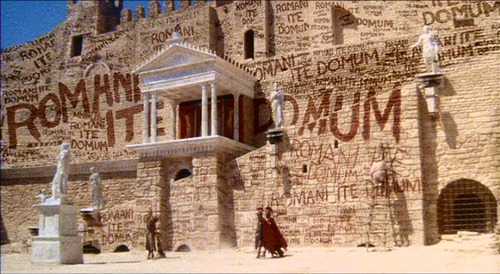
And for some reason 'Domus' reminded me of this classic 'Life of Brian' scene (below) where the centurian corrects Brian's grammar 'Romanes Eunt Domus - Romani Ite Domum' You know the one!...
If you're reading this you're probably in need of some comic releif by now. Try this link...
http://www.youtube.com/watch?v=XbI-fDzUJXI

http://media.tumblr.com/tumblr_l2n6lmshZ41qarwhv.jpg

No comments:
Post a Comment