Sunday, 26 August 2012

Week 5

Week 5:

 Lecture: Strategic New York.

There was an illustration in today’s lecture that resonated with me; I may take some of it to assignment 2. It read;

“A city block with a collective deck and a plinth for parking and amenities is an ideal urban typology that allows for different levels of social interaction” then goes on to ask; “what if building groups build up this city block around a collective interest or theme and fill its plinth with functions and amenities in relation to this theme? Would this block be a common ground that could stimulate social cohesion on different levels?”


The first quote has sound intentions regarding social interaction, however, the last part of the quote talks about social cohesion but also segregation. What I’m suggesting is that if you were to group certain collective interests – won’t we create groups that may segregate themselves from other groups through interests? The intermingling of groups may be more successful if we create mixed-groups across city blocks.


Tutorial: Design Development:

The following paragraphs are factors that we have identified for our assignment 1 panels; they form the driving mechanisms that will influence our architectural fiction.


These are the drivers that will set the stage for our architectural fiction. During the tutorial the group also discussed some proposals as to how the panels will work as a flowing story, we now have good direction to complete the project. I have offered to illustrate the storyboard montages of our fictional characters (we have decided on 3 characters) so I have my work cut out for me!
 
 
 Photo by Andrew Brown


PANEL 1:       
Start with our drivers: Global and Local, Social and Political actors.These are the catalysts for change that inform the direction of Paddington’s future

PANEL 2:               
Outline of sustainability issues.

PANEL 3:               
Storyboards illustrating characters interacting with an architectural possibility.

PANEL 4:               
Speculate on architectural manifestation.

Sunday, 19 August 2012

Week 4

Week 4:

Lecture: People and Lifestyles:

We were asked to consider a ‘storyboard’ scenario with fictional characters, scenes and sets based on reality and facts which is what our group has been doing already in our charettes.

Tutorial: Design Charette

Today we discussed several scenarios for the characters of our envisioned future Paddington. Four of the more prominent points were that;

1)       People would work more efficiently for less time – leaving more time to enjoy extra-curricular activities such as shopping.

2)       The actual shopping experience would be different to that of today due to the implementation of emerging technologies such as interactive walls.

3)       Shopping Centres would have multiple roles that would include retail, recreation and entertainment on a larger scale than that of today.

4)       We will see a greater emphasis of automation of current systems. Robot workers will undertake tasks that we do not wish to do.

TESCO HOMEPLUS:


Tesco Homeplus: In principle, quite a good idea, however the convenience of having all the stores products up in one space would make more sense. Otherwise you might be reminded to get the steaks in the subway, but what about the milk? – Next station over? – Inconvenient. The space required to make this work would be similar to an actual grocery store anyway!
The answer could be this...


Adidas has developed a hybrid virtual and physical retail experience. The shopper has the benefit of accessing hundreds of the brands products even if they are not in stock. A simple scan of your smart device completes the transaction and the product is sent direct from the manufacturer to the customer.
 
Along this scenario, the retail experience becomes a more interactive experience and goes some way to clawing back some ground on the other current option - impersonal on-line shopping.

Although people [generalisation] find on-line shopping a convenient and novel way to purchase goods, there is an important element missing; social interaction. Unless things change and we see a swing back to the social shopping experience we are in danger of becoming anti-social beings.

Indeterminacy:

I believe that buildings may become de-designed in order to accommodate a flexible indeterminate existence, Large open spaces designed for multiple life-cycles and uses may become the most useful solution. This is concerning for the profession of architecture whose traditional role was that of designing bespoke spaces for specific purposes. We almost have to be able to think harder to design less?

Saturday, 11 August 2012

Week 3


Week 3:

 
Lecture: How to Measure Sustainability.

A couple of points to highlight from the lecture:
·         Selfish Architecture = Reasons without sufficient universal appeal (merely – I want, I like or I say) are not valid reasons unless the only client is you.
I think it may be difficult to ever execute a project under this motivation as the client will always have a pretty good idea of what they want to produce. It is up to us as designers to raise awareness of other influential matters that need to be addressed.
·         Generous Architecture = Based on universal principles and a well reasoned context.
This is what we’re here for – to learn to design architecture with awareness of multiple societal issues.
I also found the Carrying Capacity Dashboard an interesting tool for measuring how much land is needed for basic self sufficiency. This is something I will re-visit in my own time.

Tutorial: Design Charette:
Today we set to work on some large paper to image what will the future of retail at Paddington Central look like. We discussed renewable energy, densification, green-space, transport, rising sea levels. Discussion with Peter Wolfe directed our vision towards time, scale and context and future requirements – all valid points that we will consider on the lead-up to assignment.


Photo by Andrew Brown


Readings: Shearing Layers:

I enjoyed this read and there is a particular paragraph that will probably stay with me forever. It's a quote by Christopher Alexader;

"What does it take to build something so that it's really easy to make comfortable little modifications in a way that once you've made them, they feel integral with the nature and structure of what is already there? You wnat to be able to mess around with it and progressively change it to bring it into an adapted state with yourself, your family, the climate, whatever. This kind of adaption is a continuousprocess of gradually taking care".

He goes on to say, "Because the adaption is detailed and profound, each place takes on a unique character. Slowly, the variety of places and buildings begin to reflect the variety of human situations in the town. This is what makes the town alive".

This supports my argument from last weeks blog.

The paragraph about ancient Roman and Greek 'Domus' reinforces my week 2 blog entry that 'house' is not just a tool for living - it is our home - it contains our possessions and memories. It speaks of security and individuality.

According to the reading the definition of Domus is both house and inhabitant as indivisible.

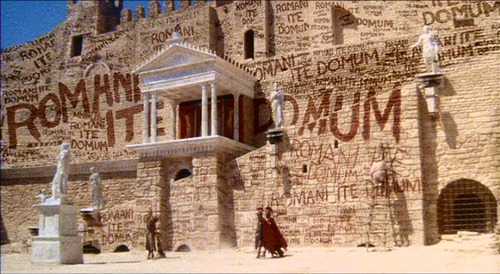
And for some reason 'Domus' reminded me of this classic 'Life of Brian' scene (below) where the centurian corrects Brian's grammar 'Romanes Eunt Domus - Romani Ite Domum' You know the one!...

If you're reading this you're probably in need of some comic releif by now. Try this link...

http://www.youtube.com/watch?v=XbI-fDzUJXI


http://media.tumblr.com/tumblr_l2n6lmshZ41qarwhv.jpg


Saturday, 4 August 2012

Week 2


Week 2:
 Lecture: Future Visions and Scenarios.
Just a personal observation regarding the majority of scenarios that depict the future: Why do they always look post-apocalyptic? – Surely we can avoid this?
Imagine me in the future...

Okay, let’s go for 20 years ahead - 2032. I’ll be 57 but appear to be in my mid 40’s because of the age defying treatments available. If only they had developed them earlier! Anyway, technology has advanced to a stage that I run my virtual architecture studio from the comfort of my home office; this alleviates the overheads of a physical practice and saves considerable time in travel. In fact, there is no need to leave the home at all as everything I require can be ordered via my smart appliances. Cabin fever is my major concern. I leave the home office on a daily basis for a walk to get some fresh air – because the air is indeed fresher since carbon neutralisation – largely due to the reduction in private transport (cars). Most people work from home in 2032, most of the remaining traffic is delivery based or public buses. Aesthetically, my neighbourhood has changed little since 2012 when all but a few blocks of land were left to purchase, however recent renovations are easily identified because of the advances in nano-technology. These homes are painted with specialised solar paint and many have shading devices developed through bio-mimicry – they adjust automatically to fluctuations in light, shade and temperature. The importance of planting increased over the last 20 years so people have been inclined to plant more and cut less – this has led to an increase in biodiversity and birdlife has flourished. Bird noises are a constant companion to me as I work and walk. The weekend is nearing and I’m starting to consider my options. The 4 day working week was introduced 13 years ago leading to a boom in any industry related to recreational pursuits and the options now available are staggering. What to do?


Tutorial: Design Charette:

Today we visualised what Paddington may be like in 50 years. We speculated that there would be a noticeable reduction in personalised traffic but increased amount of public transport. The idea of an elevated rail system or perhaps a mag-lev system may also be implemented in the future.
We brainstormed office buildings and decided that more people are likely to work from a remote interface (home perhaps) so there would be a reduced requirement for office space in the future. Some ideas about how to utilise these empty spaces resulted in proposals of residential inhabitation, food production and recreational facilities.

 
Readings:
Reading 1: Urban Form and Locality: Hugh Barton.


Dispersal vs Concentration:
On one side of the argument we find the eco-idealist. Return to rural land use, organic farming and low impact lifestyle to achieve a sustainable existence. However this ideal is being diluted by the housing market and the popular “tree-change” movement. Although people enjoy the rural lifestyle, many of the agricultural properties are being snapped up by homemakers rather than farmers. This has a negative impact on the ideal of ‘working’ communities and rural employment and produce. Also, if we consider that most of these “tree-change” advocates live in the country and retain their employ in the cities – the issue of climate change through transport emissions and increased travel distances works adversely to the eco-ideal.


http://www.futuretechture.com/

Dispersal: Urbanisation of the countryside:
Would this eco-ideal not expedite the urbanisation of the countryside as the population inflates, plots are sub-divided to sustain growing communities leading eventually to urban densities. This is already happening around the world. Is this not what we refer to as ‘urban sprawl’?

Concentration: The Compact City:
Studies based around transport suggest that dense urban communities rely less on personal modes of transportation and therefore have a smaller ecological footprint that their rural dwelling cousins. Further to this; it is suggested that densification of urban centres creates a rich and diverse cultural life for the inhabitants, but what about quality of life? (below).

 
Because of their success, researchers look towards European towns as a model for how 'concentrated' city living can work. Whilst being dense, there is a sense of community, cultural richness and social and economic organisation that can be found in many, if not most of the towns. 
 
"... Re-creating tbe diverse multifunctional city of tbe citizen's Europe is tbus a social and economic project for wbicb "tbe quality of life" is not a luxury but an essential" (CEC, 1990).

Compare the below photos; It is not until we delve into the streets of Barcelona that we see the richness of this dense European city.


Barcelona Sprawl: http://25.media.tumblr.com/tumblr_m505zrbmO71r3cgmdo1_500.jpg
  
Barcelona Street: http://www.panoramio.com/photo_explorer#view=photo&position
=243&with_photo_ id=75151162&order=date_desc&user=64515
 
"... the large majority of Europeans live happily in the very kind of suburb that the Commission designates as 'sprawl'". (Breheny, 1992a)
 
And, although dense in residential accommodation, we find that European cities like Barcelona (above) contain many public squares and parks to accommodate recreational pursuits, thus, creating an enjoyable living experience. Can we call this 'well organised sprawl?'


Mixed Use Development:
Has been earmarked as the answer to sustainable development. However the text raises the question of what should be mixed into which part of the larger township and how does this affect the reliance on public transport? It raises the importance of careful planning of mixed use patterns, in particular, the selection of uses to be incorporated into different scales of neighbourhoods.


http://www.indesignlive.com/idl/media/idlcom/february_09/sustainability/one_hero.jpg


Reading 2: Tsunami Warnings, Written in Stone:
Signs left by ancestors warning of past tragedies save those who heed the warning.
Not yet sure how this one ties in... could be development in tune with nature? Anyway I found this funny photo...

 
Reading 3: A History of Greenwashing: How Dirty Towels Impacted the Green Movement:

Again the controversy of corporate profits vs ‘Green Initiative’ rises to the surface. It’s also called positive sustainable development and allows growth and sustainability to work together for a common goal.
I have no problem in businesses making healthy profit, as long as they are doing their utmost for the sustainability of the economy and ecology at the same time.