Reading One;
Beyond Architecture: Indeterminacy, systems, and the Dissolution of Buildings.
First, lets break down this wordy heading with some definitions...Indeterminacy: the condition or quality of being indeterminate: not known exactly, or impossible to work out: not definite, precise, or clear: not having a predictable result or outcome.
Dissolution: The act of breaking something down: the separating, decomposing, or disintegrating of something into smaller or more basic constituents: the process of breaking up or destroying an organization or institution.
Right, now that we've got that sorted... let's get on with it!
Because of the size of this first reading I have broken it down to a number of key statements from the reading; followed by my reflection on them.
Key statements:
construction of the future.
Sounds like another "throw-away" statement doesn't it? Lets get real about structure here. I know there is a miriad of material that we can use for construction but I truly believe there is a place for concrete in the future. Despite the high embodied energy in concrete, advances are being made to make it more sustainable. This statement in it's context, however, aims more at the imposing 'presence' of brutalist structure. I'll have to admit at this point that I am a fan of some brutalist architecture (not all). I think that concrete can be used in beautiful ways ie. Eero Saarinen's TWA Terminal, which, in my opinion, is one of the most beautiful and underrated public buildings in the world. No shortage of concrete brutalism here.
If this building doesn't do it for you - check your pulse!

http://blog.dwr.com/.a/6a00d8345173e769e20153927054be970b-popup

http://www.mcny.org/exhibitions/past/eero-saarinen.html

http://observatory.designobserver.com/entry.html?entry=2467

http://www.tumblr.com/tagged/twa-terminal?before=1297572612
There you go... Brutal can be beautiful and tell of time and place. The world would be much poorer without architecture like this.
Evolution towards networking and transience.http://www.mcny.org/exhibitions/past/eero-saarinen.html
http://observatory.designobserver.com/entry.html?entry=2467
http://www.tumblr.com/tagged/twa-terminal?before=1297572612
There you go... Brutal can be beautiful and tell of time and place. The world would be much poorer without architecture like this.
Okay, this statement seems to suggest that the entire human race is geared towards the same aspirations! Luckily, since the 70's (note: sarcasm) we've discovered that the human race is a massive melting pot of different cultures with their own unique traits, aspirations etc. Therefore, not all of society wishes to network, in fact, the building of partitions (read: walls), whether home, office or elsewhere, is largely for the purpose of achieving privacy. I couldn't imagine not being able to get a bit of privacy once in a while. I think networking has its advantages but we should not lose the luxury of privacy. This is the time we need for quiet reflection - its healthy!

http://designkultur.files.wordpress.com/2010/01/juust-say-yes-to-privacy.jpg?w=432&h=431
Is a composition ever complete? Implied infinite extension / Endless Architecture
A good artist knows when to stop! however the push for adaptable buildings is leading to 'open-ended' design to allow for future re-use. Although this ideology appears to be sound in theory, we must know when to stop. Architecture, like art, needs to breathe. Without the ability to know when to stop we face the possibility of congesting our built environment with unfinished and ongoing works – living in a constant building site - not my idea of living...

http://thearchiblog.wordpress.com/2011/06/01/architecture-in-movies-the-fifth-element/
Handing the control levers of the environment straight over to society, and let people determine forms and spaces directly.
In a small way, this is something that we practice through community consultation. Relinquishing complete control to society would be fraught with failure – decisions of the strong would outweigh the less so. Failure to plan for the future would be inevitable as society tends to succumb to contemporary fads and redundant programming. For any level of success there must be an autocratic process in place. We must have educated decision makers to make informed compromises (drawn from community consultation) to achieve the ‘best possible’outcome for the future and the greater community.

http://www.christopherdgray.co.uk/photos/beijing-bad-architecture.jpg
Archigram 1966; “buildings with no capacity to change can only become slums or ancient monuments”.
Being a great advocate of historical architecture I find the above statement insulting! What's wrong with ancient monuments? Without static architecture we would have little history. The richness of ‘place’ is often attributed to the historical architecture of any given place – The history of any given place is an integral thread of the fabric of that particular community. Static buildings offer a timeline and tell a story of that community, therefore, the negative connotations of the above sentence could be construed as a little naive and dismissive.

Gamla Stan, Stockholm: http://upload.wikimedia.org/wikipedia/commons/d/d9/Stockholm-Gamla_Stan-1.jpg

The Plaka, Athens: http://www.athensminibus.com/eikones/plaka.jpg

The Royal Mile, Edinburgh: http://farm4.static.flickr.com/3585/3563123788_cf92416621.jpg
Character is identity, imagine these three towns without history. What would identify them? International style architecture is a curse!
Demands for spaces that allowed for human encounter as well as segregation of function.
I actually agree with this one! People need spaces where they can choose whether to express or regress. Allowing the user to have the choice is true democracy in design.

http://agreenliving.org/wp-content/uploads/2011/07/3f0c8c47ecFreyja-Sewell-Hush-Felt-Pod-1-537x358-500x333.jpg
Archigram: “A house will no longer be this solidly built thing which sets out to defy time and decay... it will become a tool as the motor car is becoming a tool”.
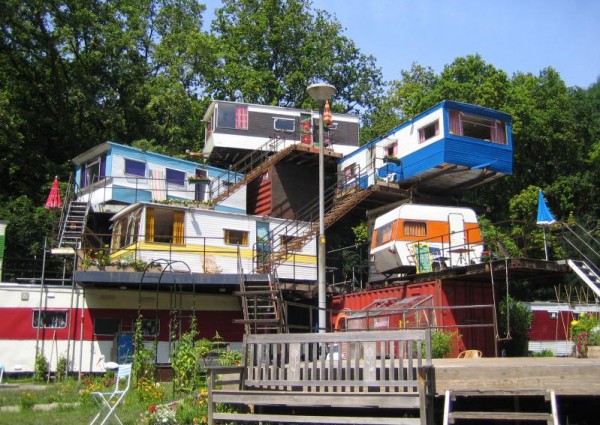
This could not possibly work. Humans are 'nesters' they like to be secure. They want a home that will defy "time and decay" (especially during their later years). Archigram missed the point that a house is more than just a disposable tool. We fill a house with familiarity and memories. A caravan is a tool!

http://www.roi4my.com/wp-content/uploads/2012/03/trailer-park-keywords.jpg
Collaboration between professions (related, or not) to push the boundaries of traditional “brutal” architecture.
We're seeing this come into fruition now. The collaboration between science and architecture, especially in the fields of biomimicry and nanotechnology is beginning to push the boundaries of traditional architecture.

http://www.designspotter.com/media/2/I1010417B/015830,53165.jpg

https://blogger.googleusercontent.com/img/b/R29vZ2xl/AVvXsEgO6A3u_46QxOxFqWF7cL_r0NHlumAK_LYzUu51LulUmfl9nmEniCTbV8Epcg9eRcpSHvD4KnUZxcok79gkHMGbI7PQ07kvAEysFuMJThk51VOO7ZQ4NzlcvnG0fzfcSClxLlY2CZH4QBc/s1600/spiraling-skyscrapers_01_zwHHX_22976.jpg

https://blogger.googleusercontent.com/img/b/R29vZ2xl/AVvXsEi0ziyXZFgtVrW0PFy4KlGyqZelXyPspCiquZ9mgVMca32fcnb_CDVUgt-RYV6H8lJqTAHmNu9YRyycOlmpD88zGW78vLOZl3OvnSLRn5i4GkUG4zfa20skkY0LV4ZtQhvFwRBGsCwaU9o/s1600/plant+spiral.jpg
As Banham asked in “A Home Is Not a House”,1965, “When your house contains such a complex of piping, flues, ducts, wires, lights, inlets, outlets, ovens, sinks, refuse disposers, hi-fi reverberators, antennae, conduits, freezers, heaters – when it contains so many services that the hardware could stand up by itself without any assistance from the house, why have a house to hold it up?
I'll answer that one... Because a house is not just a house. A house is our home. It is a place of familiarity and in some cases our home defines who we are - an extension of our identity. No one wants to see the inner workings of our house just as no one wants to see the inner workings of the human body. The 'skin' is there to hide the 'uglies'.

http://farm1.static.flickr.com/24/40339806_bbae6887e4.jpg

https://blogger.googleusercontent.com/img/b/R29vZ2xl/AVvXsEhrazBDIkcgmTDp5G7Kx24smYhJfmNZQ64t4oiLHeLT1jjZf6Nb22oSfuNNew6D7nT9hGS_fgG9aC40U47_EWHHyvDueIP9qjSyAh_mZ0o2peFuH7t-cnEz1ntkIlRnaP5DR1HiAxInLYjV/s1600/Pompidou.jpg
I believe that Archigram were challenging a movement that they could never beat. It would appear that the group had been swept up in the popular culture that they tried so hard to challenge. The gypsy/hippy movement of the mid to late 60's had influenced even architects with the notion of freedom from the 'system' and a free spirit lifestyle. Their enemy? - the 'great Western dream' of the perfect house with a white picket fence. Their arsenal? - a notion of freedom, transiency and an unsettled lifestyle - romantic and novel to a small few but unthinkable to the majority. It's upsetting to see that architects can be so far removed from their client base and what people really desire.
You choose!...

Typical Transient: http://s2.hubimg.com/u/1712173_f520.jpg

Or Roadside Rustic: (Typical 60's house) http://2.bp.blogspot.com/-5WFuHIn5rW8/UAnPFZM4SfI/AAAAAAAACWc/EQD1lmuAeDk/s1600/60's+house.jpg
Archigram pushed the limit of what design is, and like anything else, if you push too far - you will find the limit.
Peter Cook; analogy with cybernetics: inorganic architecture could operate as an extension of its organic users, each man and woman in turn a nerve ending in the social body.
Okay, this is going too far! And in the final paragraph a down-trodden Archigram admit defete as the theme of cybernetic technology enters their arguement.


To finish this reading I just had to ad my
favourite quote by Banham: “Form-fondling” - love it!
Reading 2:
Stories from the first transnational traders:
Although an interesting story, has little reference to architecture and tends to focus more on global social issues. If we focus on the architectural message of this short story we can see that structures do not have to be static in form, architecture can be transient by nature. This ‘transient’ideology was explored by Archigram in the 60’s during a time of socio-political unrest. Feelings of oppression by the “system” were being were being fought by free-thinkers seeking freedom . Parallels in the story can also be drawn from the ‘pirate’ radio stations of the 60’s. Of particular note are the offshore broadcast vessells of the time such as Radio Luxemboug and several other known vessels– legitimately anchored just beyond territorial limits.

Reading 3:
Innovations that will change your tomorrow:
Some
useful inventions and some – not so... Designing for the future will be
important as a designer. The ability for our creation to accept future
innovations will assist their ability to cycle life through adaption. How do we
design for the accommodation of future technologies?






No comments:
Post a Comment