Friday, 9 November 2012

Post Presentation

Presentation Feedback:

I appreciated the critical feedback from my presentation and will certainly take these points on board for future projects. A couple of suggestions arose from my presentation that I feel I didn’t address well during the presentation and I would like to take the time to address them now; I will aim to be much clearer on my intent for future presentations.

1) Circulation (vertical circulation).
Response: I attempted in this project to provide a method of vertical circulation in each building block. In this case I have a different means in each block; the west wing has escalators, the right wing has a lift (although it didn’t show on my printouts – you can see them clearly in the above section (beige colour with elevator doors), and a stairwell in the car park. I am now aware that this is insufficient and that fire stairs are required at closer intervals and I will make a point of remembering this for my next assignment.

2) Holographic technology may be a little far-fetched.
Response: Through research during this assignment I discovered that major technology companies Apple and Microsoft are investing heavily in holography with Apple implementing patents and trademarks in anticipation of this emerging technology. As I mentioned in the presentation, (and as seen in the youtube video that I posted in week 13 “Holographic TV coming in 2012”) we are already seeing the clumsy beginnings of this technology. Take, for instance, tablet technology. This was first imagined in science fiction shows like Star-trek 20 years ago. It has taken 20 years for this technology to become reality. Surely with technological advances increasing at exponential rates it is not out of the question to expect to see results much sooner than 2032.

3) Building appears unresolved.
Response: As I mentioned during the presentation (and you can see some of my floor plan sketches in previous weeks) I did consider a more solidified response which included internal walls however deeper reflection revealed that this traditionalist thinking is what stifled the original Paddington Central. In 2032 walls may not be necessary if we have the technology at hand to project them. For the benefit of ‘future use and re-use’the ability of the building to adapt to changes in future use hinges heavily on how flexible it is to accommodate change, thus the solution is to provide a simple, open and multi-functional floor plan.

4) Too much car parking.
Response: Yes I agree but there are two reasons for this. 1) Unless legislation enforces some kind of moratorium on personal travel and public transport improves greatly – it is still comprehensible that people will still use personalised transport. Given that the population of Paddington in 2032 will obviously increase greatly – council may still have to make provisions for this in its council planning scheme, i.e. Car Parking to GFA ratios. In the event of a reduction in personalised transportation these now empty floor plates can accommodate further retail/recreational facilities or be removed in favour of open parkland. 2) It provides the substructure for the interactive screen.

5) Holographic products are unlikely to replace the actual product.
Response: I totally agree. That’s why I made a prediction that holography would be able to replicate the sensations of touch. Advances in nano-technology are being made with amputee victims that allow them to experience the sense of touch through ‘fake’ nerves. So again, the technology is emerging. On reflection, a mixture of ‘virtual’ and ‘actual’ product may be a better option.

This assignment brief stipulated that the project had to be believable; this is why I have based all of my assumptions and imagery on current research as to what may be available to us in 20 years time.
If you got this far, thank's for taking the time, you've more than earned yourself a beer, so cheers to you.

The End.

Wednesday, 7 November 2012

Presentation

Presentation:

Assignment 2 Presentation

The following paragraphs are my two scenarios for Paddington in 2032.

Introduction:
Paddington Central had served the community well for almost 2 decades before major redevelopment was required in 2013. This was an incredibly short lifespan for a modern building. A lack of foresight during the initial design process had delivered a stifled project that lacked the ability to adapt to future scenarios. The dated styling and fixed layout meant that retrofitting new technologies was almost impossible. As a result, customer numbers dropped and the centre became untenable – re-development was required.

The site challenged designers to create a structure that would adapt to new technologies and accommodate the changing needs of the surrounding community. This buildings primary function would be to provide recreational options for the downtime of the community.


Scenario 1: The Consumer
Advances in technology have vastly improved productivity leading to less time spent at work. IT and R&D have become the new boom sectors and by 2032 the majority of people work from home by remote interface. Less time spent travelling to and from work has resulted in an increasingly efficient workforce with a richer work-life balance.
Most menial and labour-intensive jobs have been delegated to robotics post automation-revolution.

In fact, even routine tasks like shopping have been made efficient through the use of “smart-technology”. Fridges are able to sense when a product is nearing its use-by date and will prompt the resident to purchase replacement goods and even send the order.
This increase in personal down-time promotes opportunities for social interaction and recreational endeavours. Although technology allows consumers to purchase products from home, social interaction is still a necessary part of everyday life. In the past, shopping malls, centres and department stores were popular venues for social engagement however rapidly changing technology has meant that the traditional role of the shopping centre has changed. These centres have evolved into “recreational centres” and host a variety of virtual and physical experiences.

Paddington Central is the latest incarnation of such a facility. It showcases cutting-edge technology and offers the customer a variety of virtual and social activities. In fact, activities can be divided between virtual experiences and physical experiences.
Virtual experiences inhabit the west wing of the facility and include; virtual shopping in holographic stores; virtual boardrooms, offices and meeting rooms; alternate-reality suites offering experiences such as virtual holidays; virtual liaisons or just about any activity you could imagine. The virtual wing is an ever-changing mix of holographic tenants that deliver very real experiences.

Physical endeavours inhabit the east wing and include a health and wellbeing centre, gymnasium, crèche, and several bars, cafes and restaurants. All bars  cafes and restaurants are located on the east facing balconies and overlook the Warmington Street square where a huge screen is projected onto the wall of the multi-level carpark. This screen plays host to interactive advertising, major sporting and musical events, open air movies or can even become user interactive by mimicking the movements of passing pedestrians.
The entry courts glass floor allows viewing of the automated distribution centre below. Pedestrians are entertained by robotic gofers as they fetch products to be delivered, much like an oversized vending machine.

In every way - Paddington Central offers the public a visual spectacle and an opportunity to be entertained.

 The user experience is vastly different from that of the turn of the century and this is also reflected in how the centre operates behind the scenes.


Scenario 2: The Retailer
The 2020's signified a massive shift in paradigm for the retail sector. The age of internet shopping ushered the transition from a tactile, physical and social experience to a virtual, on-line and private experience.  The key concern for established retailers was the decline of walk-in customers and the inability to tailor services to individual customer needs. On-line shopping was an impersonal approach to customer service that bred a long period of retail uncertainty as customer numbers dwindled.
To combat this, the following decade saw a huge push in the development of the digital retail experience. Interactive walls became commonplace within department stores - no longer was there need to hold stock on the floor. Orders were paid for and zapped digitally to remote warehouses where an automated warehouse system was set in motion to retrieve the product and deliver it to the customer. Although ultra-efficient and cost effective, this technology lacked the tactile experience of customer-product interaction - one of the most instrumental psychological tactics to selling any product.

During this period, vast advances were made in holographic technologies. The larger conglomerates were fast to adopt the new technology, seeing it as an opportunity to fill the void. Customers were now able to interact with their virtual product both visually and physically. Holographic technology had been developed to such a standard that it was able to send electronic nerve signals from the skin's surface to the brain that would duplicate the sensations of touch - the harder you push the stronger the signal. Virtual shopping as a social outing was re-born. Shopping centres began to flourish as customers returned.
As a consequence of this technology, it was discovered that individual shops no longer required physical walls. Holographic projections could be used to not only signify perimeters but also project the regular features of a physical store to such a standard that it was almost impossible to differentiate a holographic wall from a physical wall. Although existing virtually, these holographic walls are physically impenetrable due to the signals that they send to the brain. As a result of this discovery, the arrangement of space bore infinite possibilities and tenants were able to reconfigure their spaces without physical disruption to the greater department store. Similarly, the entire outer skin of the building could be a holographic projection – able to depict any image desired, in fact time-lease on facade advertising has become a lucrative income generator for the facility.

This change in retail experience had significant consequences on the design of recreational facilities. The need for physical walls diminished as the need for open-plan space increased. Construction of department stores now resembled that of multi-level car-parks. All that was required to accommodate a modern recreational centre were columns, floor-plates, food and beverage facilities, amenities and circulation. Although sparse and austere, this construction also guaranteed the future use and re-use of the facility. Over-engineered footings guarantee that any need for further extension would be a simple case of adding more floors to accommodate growth.
Paddington Central's unique point of difference is that where other recreational facilities have remote distribution centres, Paddington Central's is located on-site. Three levels of subterranean warehouse covering a combined 28,000 cubic meters of tenable space is leased out to tenants and provides a generous income for the facility whilst entertaining pedestrians on the square above.

 
Summarise:
This developments objective can be described simply in the following points;

·         Paddington Central has been redeveloped to embrace and showcase new and emerging technologies.

·         Its simple design encourages adaptable use and future re-use.

·         The structure has been designed for ease of future extension by adding more floors as deemed necessary for future growth and densification.

·         Paddington Central encourages pedestrian interaction by allocating 45% of the ground plane to open public space.
But above all;

·         The facility’s primary objective is that of providing entertainment, recreation and relaxation for the increasingly time-rich community.

 
Other text from panels:

Technologies:
Sci-fi creations such as holographic imaging and robot workers are already a reality. Leading companies are investing heavily in the research and development of these fledgeling technologies, and by 2032 they will be seamlessly integrated into our lives to such an extent that we won’t know how we ever did without them. Technology forecasters predict that quality of life will increase as productivity is streamlined, leaving us with an improved work-life balance. It is this increase in downtime that has forced a shift in paradigm for shopping centres and malls. By 2032 we will require facilities that offer not only products but opportunities to pursue recreational endevours and social encounters.

Subway Mag-Lev:
Brisbane’s Mag-Lev Subway System was installed in 2021 as a means to improve infrastructure and reduce emissions. Paddington Central Station will be retained and updated in conjunction with the Petrie Central Development.

 
Presentation Panels:
 
2 x A1 Posters
 
 
Enlarged Individual Panel Images:
 
Site Plan
 
Technologies.
 
Features.
 
 
Floor Plans.
 
 
3D Section.


Sunday, 4 November 2012

Week 13 (c)

Week 13 (c)

So here is an update on some of my thoughts as I progress through the design;

·         Increase in productivity leads to more personal downtime.
 

People indulge in virtual experiences.

·         Adrenalin focussed: Shark Dives, F1 Drive, Skiing, Sky Diving, Flight (No fear of death).

·         Romantic Liaisons, Adventure, Space travel, Global travel, Role Play.
 

People indulge in real experiences.

·         Massage

·         Health & Wellbeing

·         Fitness

·         Social activities: Food, Drink + Entertainment

·         Shopping
 

 Huge interactive screen for advertising/sports events/movie screenings.

I am considering this as a replacement for my automated mechanism as a means of patron entertainment. I have other ideas for my mechanismt...

·         The screen should be placed in a prominent position for the entertainment of patrons.

·         Should be a centrepiece of the facility.

 
Warehouse:

Floor space is rented out in cubic meters to brands and tenants

Fully automated warehouse (visible through the glass floor on entrance square).

·         This is my new position for the automated mechanism – still acting to entertain visitors to the site.

Deliveries and despatch via carpark – however the abolition of B-Doubles from the city means that infrastructure only needs to cater for smaller delivery vehicles.

Car park = +200 parks. Current council scheme 2032 has reduced the number of car parks required of such a development but due to the amount of personal transport still remaining on our roads, amenity to accommodate them is still necessary. The abolition of vehicles from the site will eventually result in the carpark facility being retro-fitted into further retail/entertainment facilities as required.

 
Subway Infrastructure: established as Paddington Station.

The subway has existed for over a decade so the station is in need of a minor facelift to compliment the new Paddington Central.

 
Okay... back to modelling...
 

Here I am looking at the possibility of cantilevering the building out to allow a walkway to be placed around the perimeter of the building (protection against the elements), although it seems to contradict the visual impact of the solid form.


Here I have shifted focus to the entry square and the glass floor in particular. Here visitors can look down and watch the theatre of the automated delivery centre at work – complete with lighting effects.


I have created a scaffold-like framework for my plug-in modules, I envisage these C-Sections to patina with age and for planting to cover them eventually adding a soft contrast to the geometry of the main building.


Here I have added the
columns to the carpark as per the original drawings.
 

And now I have added columns to the main building as per the existing drawings.


I have shifted my attention to the rooftop treatment so I’m back to scribbling on paper again!


Curved steps to sit on?


I am considering how to incorporate public green-space as a break-out area as well as create a market feel. . I believe this is a much needed contrast after being inside the facility.


The plug-ins on the left will act as market stalls for visitors to the rooftop. Try to imagine it with Jasmine or similar creeping over the steel frame.


So now I’m concentrating on a bit of landscaping for the ground level podium and working between paper sketches and the Revit model.


After much iteration... this is the one! (above) The big Y shape is the glass floor.


I’ve gone for a stepped landscape to allow visitors to use the grassed area as seating, especially convenient for the big-screen. The risers are to be illuminated.
 

Another render - I wanted to see what it would be like to walk towards the entrance.


View from Warmington St highlighting the landscape treatment.


This is an attempt at an evening render in draft mode. It looks okay but the render time is out of control! Way too long.

The top floor needs to be lit as does the ground floor.


Adjustments to the lighting have been made and now the entire building has been lit. I will leave it to render in high quality mode over night.

So I checked it this morning and it was only at 20% - after 7 hours of rendering. An executive decision had to be made... I had to let it go. I can’t afford to wait another 28 hours in the hope that it will turn out fine.

Onward-and-upward, Daylight renders will have to be the order of the day.


So this is how the daylight render turned out in high quality. This should be fine to work with in Photoshop.


I tried to capture the view through the centre of the building but it’s just too confusing to make out... frustrating!


I decided to carve a void into the north face to reflect the south (entry) facade and to encourage natural light and cross ventilation into my building. It also ads a great point of interest once inside the structure. This has also divided the structure into a west wing and east wing. I propose to contain virtual activities in the west wing and physical activities in the east wing.
I have considered a system of retail stores in the west wing that face outward to guide circulation around the perimeter by the curtain walls.
With the escalators in (to the right within the void), I now have vertical circulation in the west wing. Being central, this will be the primary mode of vertical circulation within the building.
 
 
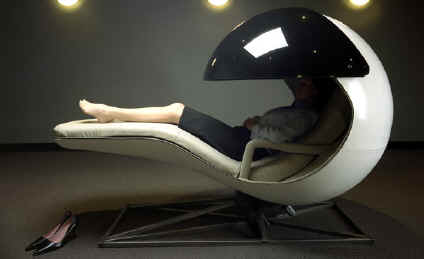
It’s time for another break from the model. This time I’m looking for virtual reality pods that could be used in the facility.


http://th07.deviantart.net/fs71/PRE/f/2012/274/9/1/cryo_stasis_pod_concept_002_by_alxfx-d5ghppj.jpg

Okay back to the model.

I have just installed my elevated walkways to allow circulation between the west and east wings. I have made a conscious decision to include more than one method of vertical circulation. I now have  escalators, a lift and stairs (carpark).


Elevated walkways and escalators provide circulation between west and east wings.


This view shows how the design can be extended vertically as growth and densification deem necessary (note the additional floorplates).
Delivery corridor has been retained however does not accommodate B-Doubles. Delivery vehicles have been reduced to fleets of smaller, fuel efficient, manoeuvrable trucks.


This is my finished main render complete with 2030 model car and holographic walls. Note the lights happening under the glazed floor in the public square.

Pug-in stores become income generators through lease of advertising space. Advertising can be switched off to enjoy the views or access views to the giant screen.

I have left the Warmington St side of the carpark unadorned to show it’s structure, however, I envision that images will be projected onto this facade also; Perhaps an image that reflects the character of the street or maybe just greenery. The choices are endless.